


Yield usually goes missing in four or five small places, none of them big enough to notice on its own, and at least two of them recoverable. You find them by weighing the same material at each point where it changes hands, and comparing each step against a written standard instead of last month’s figure.
In this issue: six weigh points from gate to invoice · three news items, including GST credit on expired stock · one AI use case
Why doesn’t the month-end yield figure show the loss?
Because it’s one number covering six steps. A month-end report that says “83% yield, about the same as last month” can hide a vendor short-supplying you, a sorting line throwing away good material, and a filling machine giving product away, all at once. Each one is a small percentage. Together they’re real money, and the comparison with last month hides them, because last month had the same leaks.
The fix isn’t a better report. It’s weighing at more points.
What are the six weigh points?
Follow one lot of raw material from the gate to the invoice. It changes hands six times, and each handover is a place where weight can disappear without anyone writing it down.
- Vendor’s bill → your weighbridge. What you paid for against what arrived.
- Weighbridge → after cleaning and sorting. Stones, stems, dust, rejected pieces.
- After cleaning → after processing. Moisture loss in drying, frying or cooking, and anything gained (oil absorbed, water added).
- Process → bulk finished product. Grinding dust, sieve tails, spillage, material left in the equipment.
- Bulk → packed and declared. Giveaway: product packed over the declared weight.
- Packed → invoiced. Seal rejects, print rejects, damages, samples.
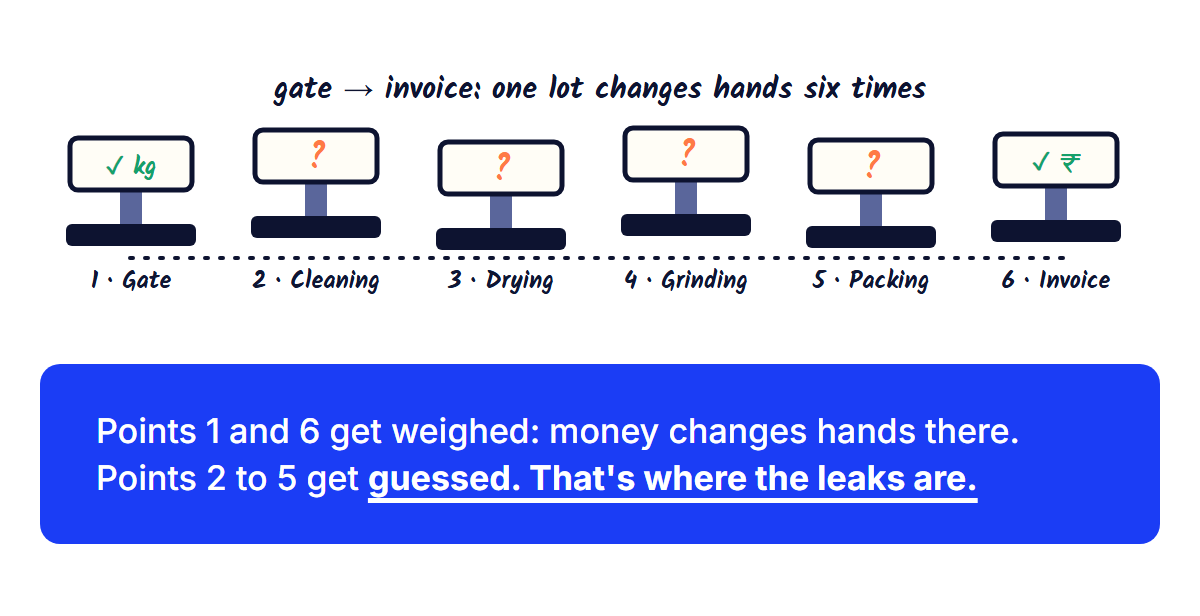
Most plants measure points 1 and 6 well, because money changes hands there. Points 2 to 5 are usually estimated, and that’s where the leaks are.
What does it look like in a real plant?
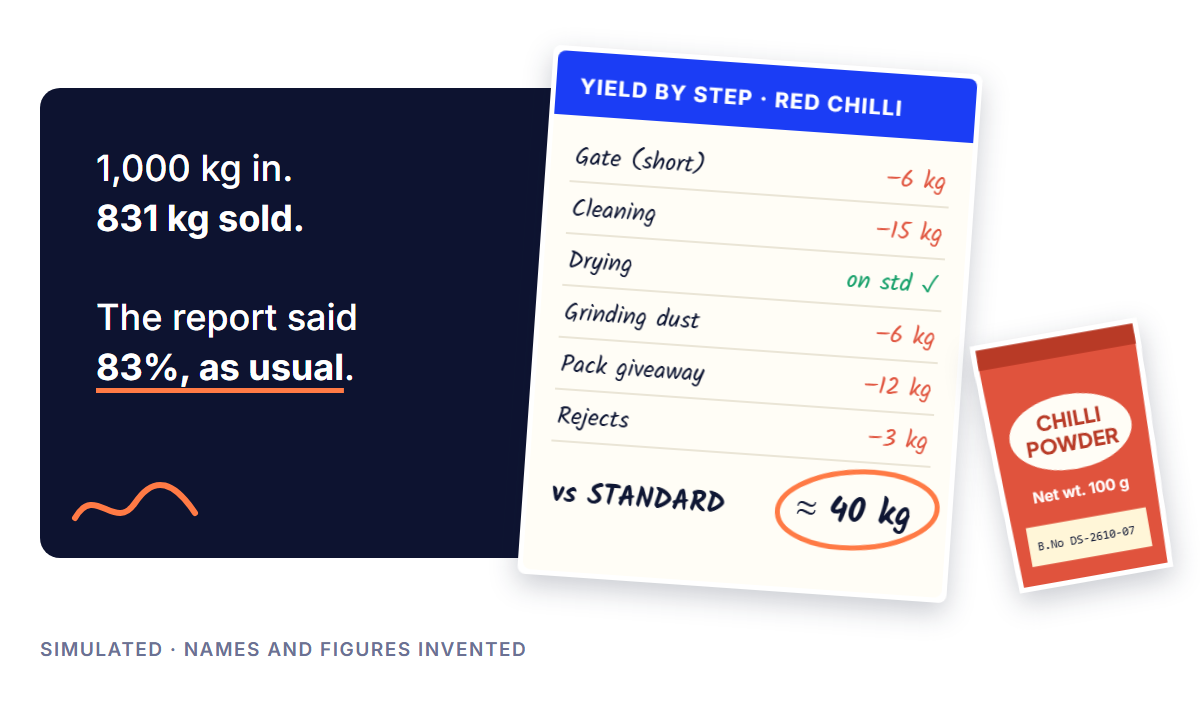
Simulated example: one tonne of whole red chilli through Doaba Spice Mills, Jalandhar (an invented name), packed as 100 g pouches of chilli powder.
| Step | Standard | Actual | Weight left | Gap vs standard |
|---|---|---|---|---|
| Vendor bill | 1,000 kg | |||
| 1 · Weighbridge | 0% | −0.6% | 994 kg | 6 kg short-delivered |
| 2 · Cleaning and destemming | −8.0% | −9.5% | 900 kg | ≈ 15 kg more removed than standard |
| 3 · Drying | −2.5% | −2.5% | 878 kg | on standard |
| 4 · Grinding and sieving | −1.5% | −2.2% | 859 kg | ≈ 6 kg lost as dust |
| 5 · Packing (100 g pouches) | 1% over declared | average fill 102.4 g | 838.8 kg declared in 8,388 pouches | ≈ 12 kg given away beyond the 1% target |
| 6 · Seal and print rejects | 0.5% of pouches | 0.9% | 8,313 pouches invoiced | ≈ 3 kg |
| Sold | ≈ 870 kg | 831 kg | ≈ 40 kg per tonne |
On the month-end report this plant sees 83% yield, close to last month, and moves on. Split by step, four of the five gaps have a clear owner:
- The vendor (steps 1 and 2): 6 kg short at the gate, and a lot that needed 1.5% more cleaning than the standard. That’s about ₹4,000 a tonne the plant could raise with the supplier, if it has the gate weight and the cleaning rejects written down against that lot.
- Maintenance (step 4): grinding loss above standard usually means worn filter bags on the cyclone, or a sieve that’s started letting fines escape. It’s a spares problem, not a yield problem.
- The packing line (step 5): the filler is set “a little high to be safe”. 2.4 g a pouch doesn’t sound like much. Across 8,388 pouches it’s 20 kg, and 12 kg of that is beyond any sensible safety margin.
That’s about ₹10,000 lost on every tonne. At 30 tonnes a month, it’s around ₹3 lakh a month, inside a yield figure that looked normal.
All figures in this example are invented for illustration. Standards vary by product, variety and season; set your own from your own good batches.
Why do packing lines overfill?
Because short weight is a legal problem and overweight isn’t. A pack below its declared net quantity, beyond the small error the rules allow, is a Legal Metrology offence, so the line is set high “to be safe”, and nobody checks how high.
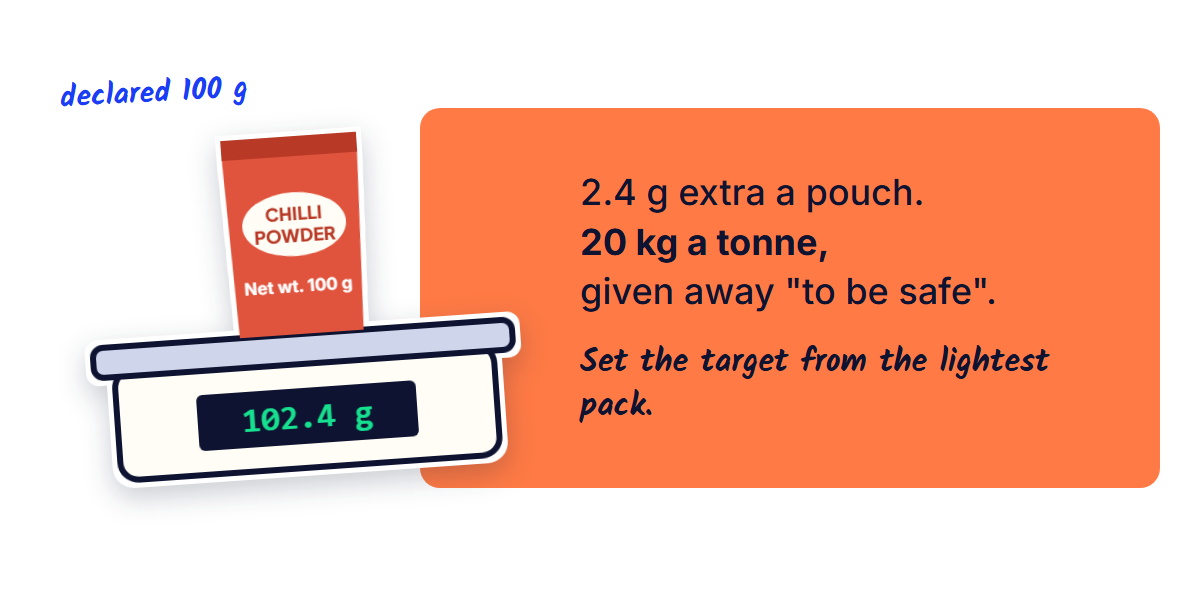
The fix is to measure, not to guess. Take ten packs off the line every hour, weigh them on a calibrated scale, and write down the average and the lightest. Set the target from the lightest pack, not from a round number. Most plants that do this for a month find they can bring the average down by a gram or two without a single pack going under.
If you have a checkweigher, it is probably already recording every pack. The data is in the machine. The question is whether anyone reads it.
Which weigh points should you start with?
Two, not six. Pick the two you can measure next week with equipment you already have:
- Gate (step 1). You have a weighbridge. Record its weight against the vendor’s bill for every lot, and note the difference on the receipt (GRN). After a month you’ll know which suppliers short-deliver, and you’ll have the paper to raise it.
- Packing (step 5). You have a scale. Ten packs an hour, written on a sheet beside the filler.
Add the middle steps once those two are routine. Each one needs a weighing at the start and end of the step, written against the batch, and a standard you’ve agreed with your production head.
The honest caveat: a yield standard is only useful if it’s yours. Copying a percentage from a consultant or a competitor tells you nothing, because varieties, seasons and machines differ. Take your five best batches from last season, average them, and call that the standard. Then argue about it.
In the news


GST Council recommends unblocking input credit on expired stock and free samples.
At its 57th meeting on 8 October 2026, the GST Council recommended removing some blocked credits, including on goods written off because their shelf life expired and on free samples. It also recommended 90% provisional refunds in inverted-duty cases, and lower maximum penalties. These are recommendations and take effect only once notified. There was no change to GST rates on processed food.
Summary on TaxGuru
Why it matters: today the input tax credit on stock you write off is reversed. If this is notified, the expired stock and samples behind step 6 above stop costing you the GST as well. Worth asking your CA to watch for the notification.


Red “high sugar, salt or fat” labels on the front of the pack are coming, in one go.
In an affidavit to the Supreme Court reported on 24 September 2026, FSSAI said it will bring in a red front-of-pack warning for foods high in any one of sugar, salt or fat, in a single phase. It expects about four months to draft the rules, then a 60-day comment period, then one year for businesses to comply. Single-ingredient products such as oil, ghee, salt and sugar are proposed to be exempt. On 28 September the Court reserved its order and questioned whether a full year to comply is justified, so the timeline could get shorter.
ThePrint
Why it matters: namkeen, bakery, sauce and beverage brands should list which SKUs would carry the label, and when packaging stock will next be reprinted. Printing a year’s worth of pouches in 2027 could mean writing a lot of it off.


PMFME’s extension has run out, and the renewal isn’t confirmed yet.
The PM Formalisation of Micro Food Processing Enterprises scheme, with its 35% credit-linked subsidy up to ₹10 lakh per unit, ran on a temporary extension to 30 September 2026 after reaching its two-lakh-unit target. The Ministry of Food Processing Industries has proposed continuing it for 2026–31, and its Secretary said in August that an extension would be announced “very soon”.
ETV Bharat
Why it matters: if you’re planning a second, smaller unit, or a supplier of yours is, check the scheme’s status before you count on the subsidy.
One AI use case worth watching: testing raw-material quality at the gate, by lot
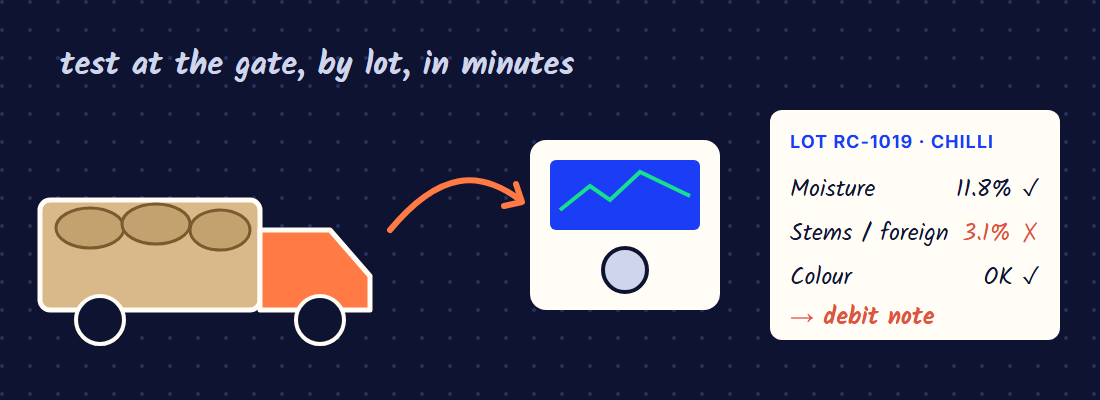
Steps 1 and 2 above, short weight and excess cleaning loss, are the two gaps the vendor should pay for. Most plants can’t recover them because quality at the gate is judged by eye, and “the chilli looked fine” doesn’t support a debit note.
Quality-analysis tools use near-infrared spectroscopy, cameras and machine-learning models to test a sample at intake: moisture, foreign matter, colour, grain or pod quality, and for some commodities adulteration. The result comes back in minutes, attached to the lot, instead of days later from a lab. AgNext Technologies, based in Mohali, sells this for grains, spices, milk and oilseeds, and other Indian firms do the same for onions, potatoes and fruit. The vendors’ own claims, published on NITI Aayog’s frontier-tech portal in 2023, are faster testing and lower testing cost. NITI notes that it hasn’t validated those figures, so treat them as claims.
What it needs first: a written quality specification for each raw material, agreed with your suppliers in advance, so the result has something to be compared against; a lot number on every receipt, so the result attaches to something; and a habit of sampling every lot, not just the ones that look wrong.
What it costs: no reliable published price. Some vendors offer pay-per-use or leasing as well as purchase.
The honest limit: the models are trained for each commodity, and sometimes each variety, so check that yours is covered. A test result doesn’t recover money by itself: it becomes a debit note only if the specification was agreed before the truck arrived. For a plant buying from a few large suppliers, start with the specification, and add the device once suppliers have accepted the test.
Questions plants ask about yield loss
What is a normal yield for a food processing unit?
There isn’t one. Yield depends on the product, the raw-material variety, the season and the machines. The useful comparison is against your own standard for each step, set from your own good batches, not against an industry figure.
How do we set a yield standard if we’ve never had one?
Take your five best batches of the product from the last season, average the loss at each step, and write it down. Review it at the start of every season. A rough standard you use beats an accurate one nobody looks at.
Is overfilling packs illegal?
No. Underfilling below the declared net quantity, beyond the small error the rules allow, is what the Legal Metrology rules penalise. Overfilling is legal, but it’s product you give away. The goal is the smallest margin that keeps every pack at or above the declared weight.
Can we claim the weight difference from the supplier?
Only if you’ve recorded it: your weighbridge weight against the bill, and the cleaning rejects against that specific lot. Most vendor conversations fail because the plant has the number for the month, not for the lot.
Do we need software to track yield by step?
Not to start. A sheet per batch with the weight in and out at each step is enough to find the leaks. Software helps when you want to see the trend across hundreds of batches without someone adding it up by hand.
How does your plant work out yield? Send us the figure you actually use and how it’s calculated (one number for the month, by product, or by batch) at sales@digiwah.com. Two or three of the most common methods will go into a later issue, with names removed.
Missed Batch 01? It’s on how long your plant would take to trace one batch, and how to find out in an hour: read Batch 01.
The Batch is written by Bipanjeet Singh at Digiwah Technosys, a Zoho implementation partner in Mohali, building batch-wise yield in an ERP and debit notes against a supplier lot. It arrives on the 2nd and 4th Tuesday of every month at 7:30 am. Subscribers also get One Batch, Five Registers, our longer guide to batch records in food plants.
Next issue, Tuesday 10 November.
