

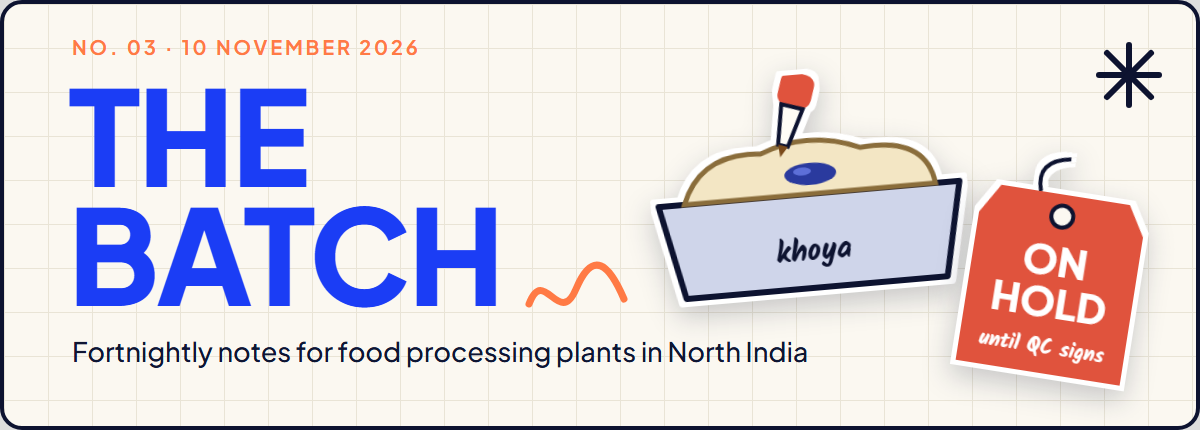

In most plants, nobody checked the lot. The truck was weighed, the bill was checked, and the bags went to the store. The first real check on the material comes when the finished product is tested, and by then the lot is inside a hundred batches. A ten-minute check at the gate, done the same way for every lot, moves that check to the point where it’s still cheap to say no.
In this issue: a gate check for every lot · three news items, including this Diwali’s sample results in Haryana · one AI use case
Why does the gate matter more than it used to?
Because when something goes wrong, the trail now leads back faster. This Diwali, about one in five of the sweet, khoya, milk and paneer samples tested in Haryana failed (more in the news below). When a sample fails, the inspector starts from the pack and works back to where the material came from. The pack carries your licence number, not your supplier’s.
A recall last month showed the other side. A regulator named one batch number of one product, not the brand. A plant that knows which supplier lot went into which batch recalls one batch. A plant that doesn’t, recalls the month.
What should happen at the gate?
Five things, for every lot, before it goes into stock. None of them needs a lab.
- The paper. The supplier’s invoice, the supplier’s own lot or batch number, and for spices, oil, flour and other packed inputs, a certificate of analysis (CoA) for that lot. No lot number, no entry.
- The look, smell and temperature. Colour, smell, damp or torn bags, insects. For milk, khoya and paneer, the temperature on arrival, written down, against the limit in your specification.
- A quick test, where one exists. FSSAI’s DART booklet (Detect Adulteration with Rapid Test) lists simple tests. Two are worth doing every time in a sweets or namkeen unit: a few drops of iodine on khoya or paneer (it turns blue if starch has been added), and a spoon of chilli or turmeric powder sprinkled on water (brick powder and sand sink fast, and added colour streaks).
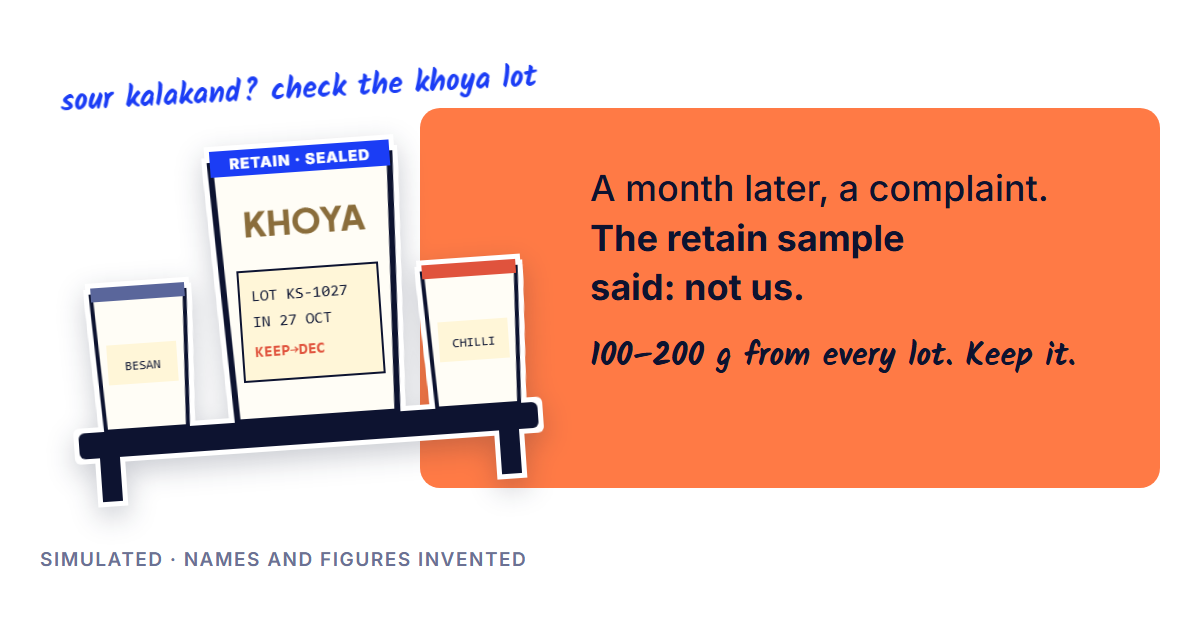
- A retain sample. 100 to 200 g from each lot, sealed, labelled with the supplier lot and date, and kept until the shelf life of the finished product made from it has run out.
- A hold tag. The lot sits as “on hold” until QC signs it off. Stores can’t issue a lot that’s on hold, and production can’t ask them to “just this once”.
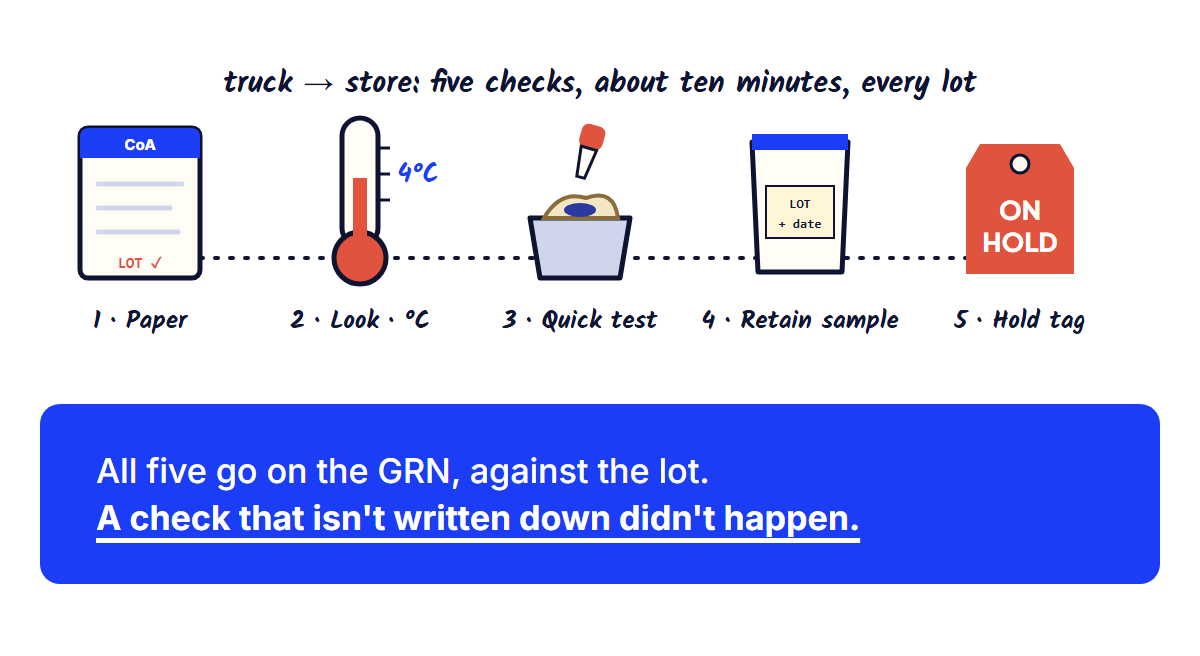
Write all five on the goods receipt (GRN), against the lot. A check that isn’t written down didn’t happen.
What does a busy week look like?
Simulated example: Karnal Sweets & Namkeen, Karnal (an invented name). The week before Diwali: 14 lots received.
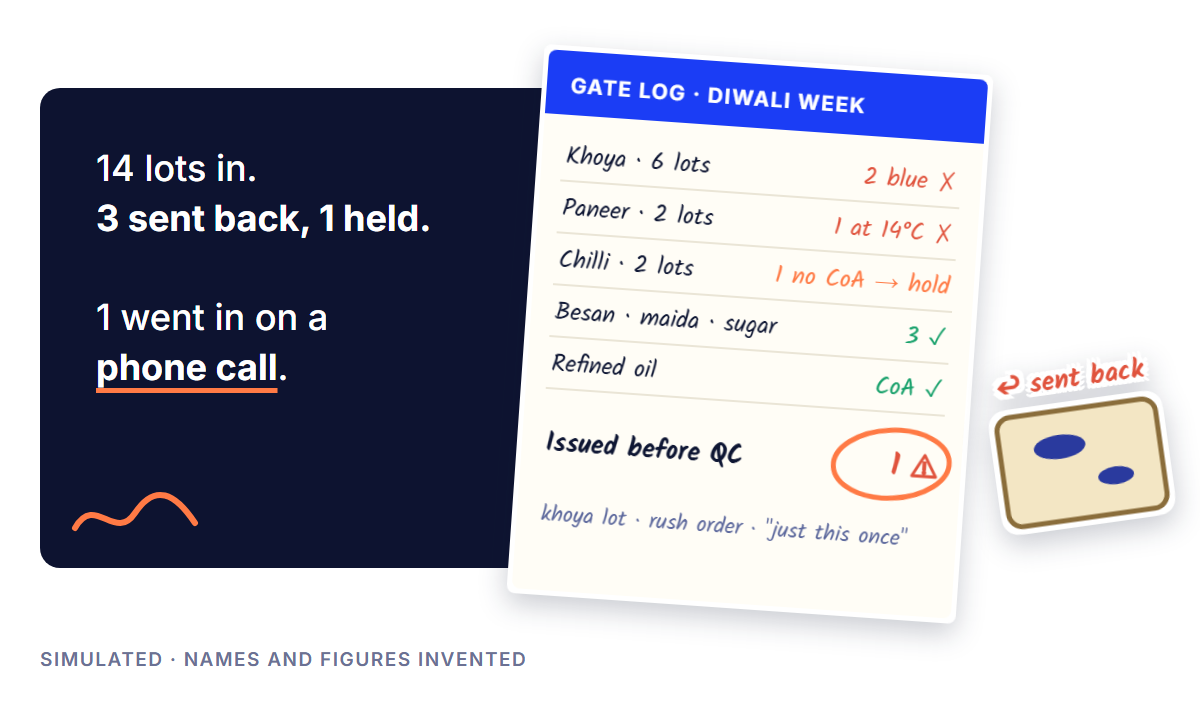
| Material | Lots | Result |
|---|---|---|
| Khoya (3 suppliers) | 6 | 2 lots blue on the iodine test, sent back |
| Paneer | 2 | 1 lot arrived at 14 °C, against a spec of 4 °C; rejected |
| Chilli powder | 2 | 1 lot without a CoA; held, CoA arrived next day |
| Besan, maida, sugar | 3 | passed |
| Refined oil | 1 | passed, CoA attached |
| Issued before QC release | 1 | a khoya lot, on a rush order |
Three things stand out:
- The test paid for itself on day one. Two khoya lots, about 180 kg, went back on the same truck. Without the iodine test they’d have gone into barfi and out to 40 shops.
- The CoA hold annoyed everyone and was right. Production wanted the chilli that morning. The CoA came the next day and was fine, but the one time it isn’t, the lot is already in namkeen.
- The rush-order lot is the one to worry about. It passed later, but it was issued on a phone call. That’s the gap a hold tag closes: not a rule people agree with, but a status the store system won’t let them skip.
A month later, a shop complains about a sour batch of kalakand. The plant opens the retain sample of the khoya lot that went into it, sends it to a lab, and it’s clean. The problem was storage at the shop, and the plant can show it.
What is a CoA worth?
A certificate of analysis is the supplier’s own test report for a lot. It’s useful, and it has limits:
- Check it’s for this lot. The lot number on the CoA should match the lot number on the bag and the invoice. A CoA for “chilli powder, October” isn’t one.
- Check it against your specification, not theirs. Moisture, colour value, foreign matter, and for spices, the pesticide limits that apply. If you’ve never written a specification for a raw material, the CoA can’t be “within spec”.
- Remember who wrote it. A CoA is a supplier’s claim. Once a quarter, send one lot from each supplier of a high-risk input (spices, khoya, oil) to a NABL-accredited lab, and compare the lab’s result with the supplier’s CoA. A supplier whose numbers never match the lab’s is telling you something.
Where should you start?
Two habits next week, not five:
- A lot number on every GRN line. If the supplier doesn’t print one, use the invoice number and date. It’s the link everything else hangs on, including the trace in Batch 01.
- A retain sample from every lot. A shelf, a box of sealed pouches, a label with the lot and date. It costs almost nothing and it’s the only evidence you’ll have when a complaint arrives months later.
Add the quick tests and the hold tag once those are routine.
The honest caveat: a gate check catches crude adulteration and bad handling. It won’t find pesticide residues, aflatoxin or most chemical contamination. For those you need the supplier’s CoA, a lab test now and then, and suppliers you’ve chosen carefully. The gate check doesn’t replace any of that. It makes sure that when something does go wrong, you know exactly which lot it was.
In the news


This Diwali, about one in five tested samples failed in Haryana.
Haryana’s Food and Drug Administration said on 3 November 2026 that a special drive since 1 October collected 1,288 samples of sweets, khoya, milk, paneer and other foods. Of the 861 tested so far, 140 were substandard and 30 unsafe. Nearly 50,000 kg of adulterated sweets and fake paneer was destroyed. UNI
Why it matters: if you buy khoya or paneer for your own products, these were the markets you were buying from. A failed sample of your product leads to your licence, so the iodine test at your gate is cheaper than the one an inspector runs on your shelf.
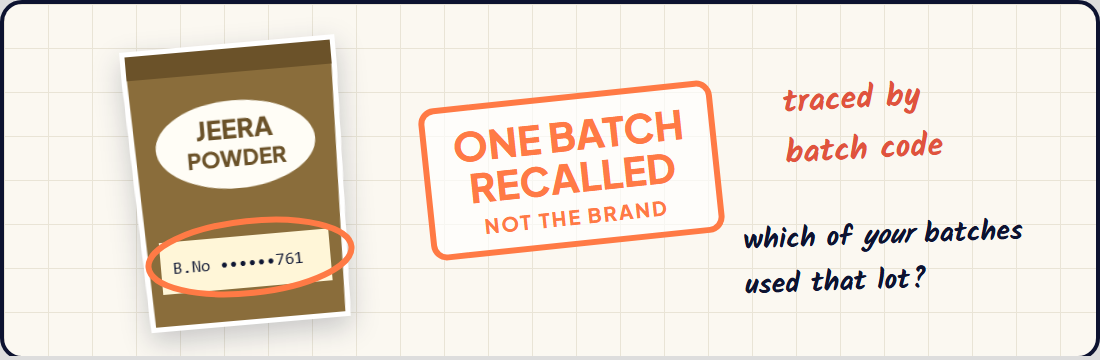

A recall that named one batch number.
On 4 October 2026, FSSAI ordered a national spice company to recall a single batch of its packed cumin powder after two laboratories found two pesticide residues above the legal limits. The sample had been picked up from a hotel in Goa, not the factory. The order covered that batch only. Business Today
Why it matters: the recall was one batch because the batch code could be traced. If that cumin had been an ingredient in your masala, could you say which of your batches it went into? That’s the supplier lot number on your GRN.
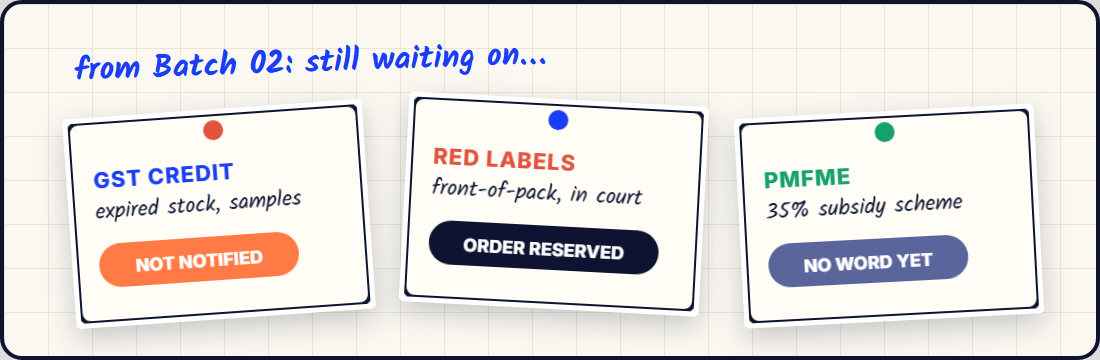

Following up on Batch 02: all three still waiting.
- GST credit on expired stock: still a GST Council recommendation and not yet notified; one report expects the change from the next financial year. Daily Excelsior
- Front-of-pack red labels: the Supreme Court’s order is still reserved. A parliamentary committee has now also raised the delay. Business Standard
- PMFME subsidy: no continuation announced since the scheme’s term ended on 30 September.
One AI use case worth watching: reading supplier CoAs so a person doesn’t have to
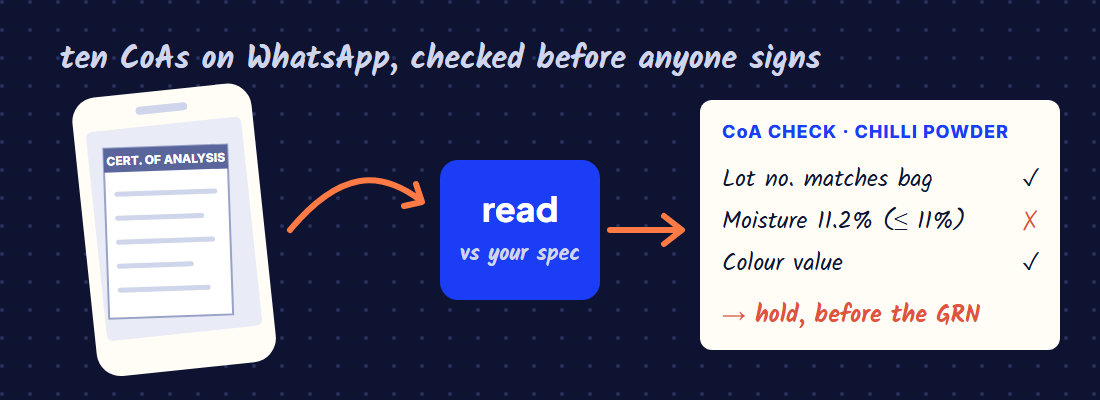
The CoA check above sounds simple, and in a busy week it’s the first thing skipped. Ten lots, ten PDFs or photos on WhatsApp, each in a different format, and someone in stores who has to compare moisture 11.2% against a spec they can’t find.
Document-reading AI can take a CoA as a PDF or a phone photo, pull out the lot number and the test values, and compare them against your specification for that material. A lot whose CoA is missing, is for a different lot number, or has a value outside spec is flagged before the GRN is approved. General-purpose AI models can already read most printed lab reports. The work is in connecting it to your receipt process.
What it needs first: a written specification for each raw material, with the limits as numbers; a lot number on the GRN to match against; and one place where CoAs arrive, not five people’s WhatsApp.
What it costs: little for the reading itself. The cost is setting up the specifications and the connection to your GRN.
The honest limit: it reads what the supplier wrote. It can’t tell you whether the supplier’s lab is honest, which is why the quarterly lab check stays. Handwritten or blurred reports still need a person. Worth it once you receive more than a handful of lots with CoAs a week. Below that, a printed checklist beside the store is faster.
Questions plants ask about raw-material checks
Do we need a lab to check raw material at the gate?
No. Most of the gate check is paper, look, smell and temperature, plus a few quick tests from FSSAI’s DART booklet. A lab is needed for pesticide residues, aflatoxin and other chemical tests, which is why a periodic lab test per supplier matters.
How long should we keep a retain sample?
Until the shelf life of the finished product made from that lot has run out, plus a small margin. That covers you for any complaint about a product still in the market.
What if a supplier doesn’t give a lot number?
Use their invoice number and date as the lot, and write it on every bag before it goes into store. Then ask the supplier to print a lot number from the next delivery. Good suppliers already do.
Is a supplier’s CoA enough?
It’s a good start, not proof. Check it’s for the same lot, compare it against your own specification, and send one lot from each high-risk supplier to an accredited lab every quarter to see whether their numbers hold.
Who should be allowed to release a lot from hold?
One named person in QC, and a back-up. Not stores, not production, and not the owner on the phone. If anyone can release it, the hold means nothing.
