



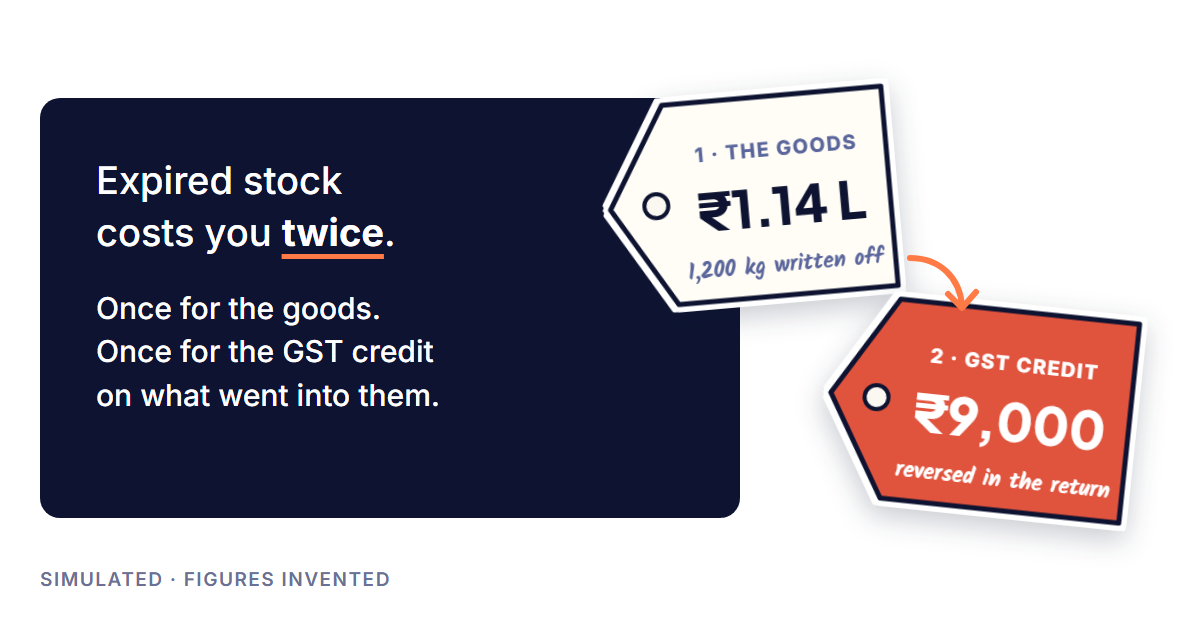
In most plants, nobody decides. The stock sits in the godown and someone notices it on the day it expires. By then, the only option left is to write it off. That write-off costs you twice: once for the goods, and once for the GST input credit on everything that went into them, which has to be paid back. A short review at 90, 60 and 30 days left moves the decision to when you still have choices.
In this issue: a 90/60/30 review for near-expiry stock · the GST cost of a write-off · three news items, including FSSAI’s festive-season drive · one AI use case
Why does near-expiry stock cost more than it looks?
Because the loss shows up in three places, and usually only one of them gets counted.
- The goods. Material, labour, packing, power. This is the number people see.
- The GST credit. Under GST law today, the input tax credit (ITC) on goods that are written off or destroyed is blocked. If you claimed credit on the oil, packaging and other inputs that went into an expired batch, that credit has to be reversed. On a large write-off, it is real money, and many plants find out only when their CA asks.
- The buyer’s shelf-life rule. Stock becomes unsellable well before its expiry date. Many buyers won’t accept stock with less than a set share of its life left. For example, FSSAI has asked online food sellers to deliver with at least 30% of the shelf life or 45 days left. So for most of your channels, the real deadline comes before the date on the pack.
Add those up and a batch with 60 days left isn’t “fine for two more months”. For some channels it’s already late.
What does a 90/60/30 review look like?
Once a week, list every finished-goods batch by days left, not by date of manufacture. Then take one decision per batch, at three points:
- 90 days left: route it. Send the batch to the channel that still accepts it, such as general trade, a distributor or institutional buyers, before modern trade and online buyers refuse it. Pick it first on every order (FEFO: first expiry, first out).
- 60 days left: push it. A scheme, a discount to a distributor, a bundled offer, or a staff and canteen sale. Decide the price now, while the price is still a choice.
- 30 days left: close it. Rework it if your process and your FSSAI licence allow it. Otherwise, write it off and destroy it properly, with a record. Don’t let it drift into “we’ll see”.
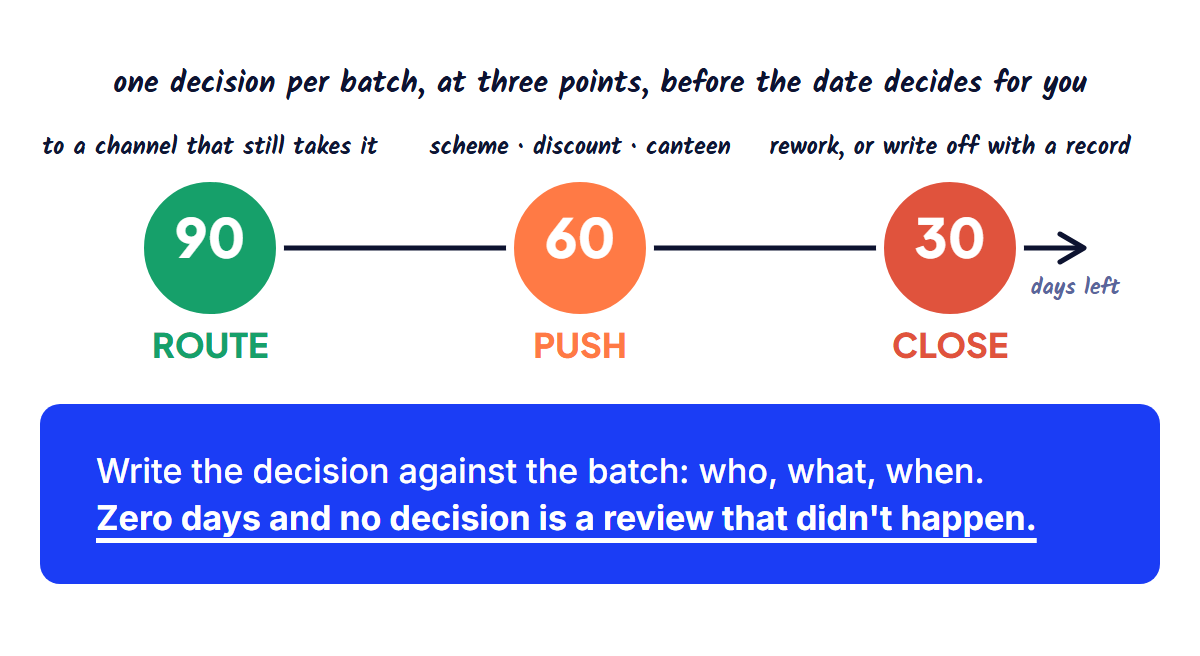
Write the decision against the batch: who decided, what, and on which date. A batch that reaches zero days with no decision on record isn’t bad luck. It’s a review that didn’t happen.
One more line on every batch: the last-ship date per channel. If a buyer needs 45 days left on delivery and transit takes 5 days, then for that buyer, a batch with 50 days left is already at its deadline. Work out this date once for each channel and print it on the weekly list.
What does it look like in a real month?
Simulated example: Doaba Bakery Products, Jalandhar (an invented name). Rusk and biscuits, 9-month shelf life. The weekly near-expiry review, first week of the month.
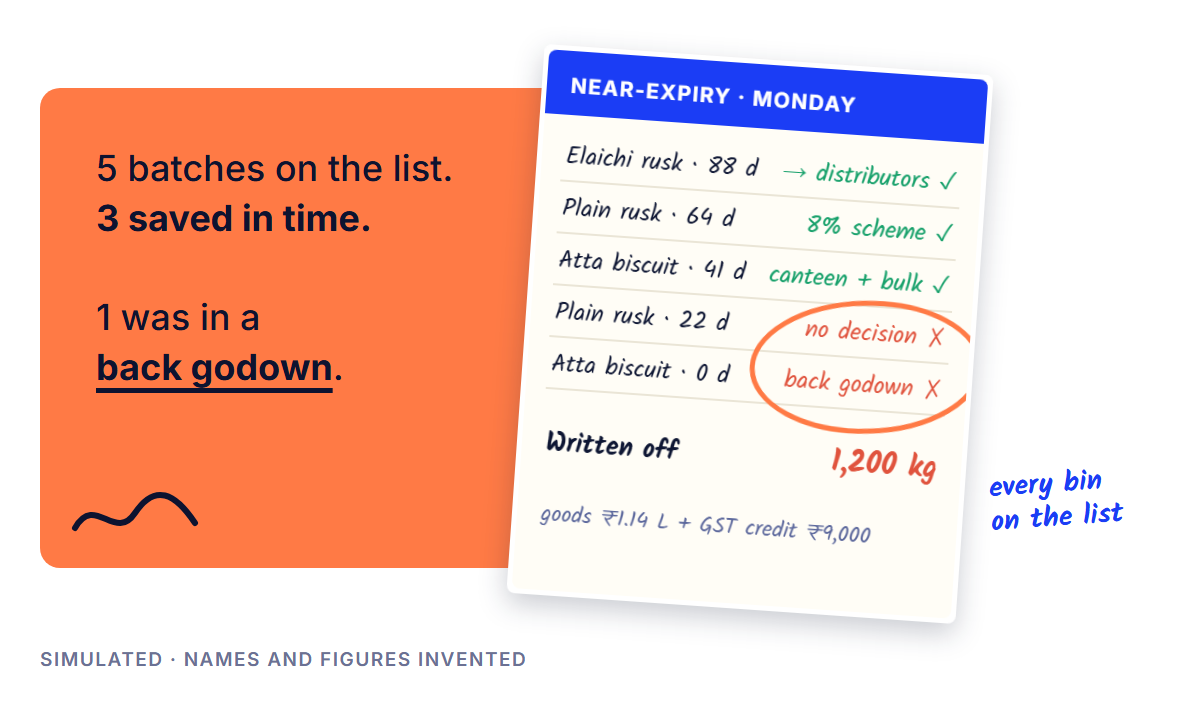
| Batch | Product | Days left | Qty (kg) | Decision |
|---|---|---|---|---|
| RK-2603-B | Elaichi rusk | 88 | 1,400 | Moved from modern trade to two distributors |
| RK-2604-A | Plain rusk | 64 | 900 | Distributor scheme, 8% off, sold in 3 weeks |
| BS-2603-C | Atta biscuit | 41 | 600 | Staff and canteen sale, rest to a bulk buyer |
| RK-2602-A | Plain rusk | 22 | 750 | No decision recorded since the last review |
| BS-2602-B | Atta biscuit | 0 | 450 | Found in a back godown during the stock count |
Three things stand out:
- The review saved the first three batches. About 2,900 kg moved before any buyer refused it. The 8% discount on RK-2604-A is a cost, but a much smaller one than writing it off.
- The two bottom batches cost the most. 1,200 kg written off at about ₹95 a kg is ₹1.14 lakh of goods. The GST credit on the oil, packaging and other inputs in those batches, about ₹9,000, also had to be reversed in the return. Total cost: about ₹1.23 lakh, plus the cost of destroying it.
- The batch in the back godown is a system problem, not a people problem. It was in a bin nobody’s report covered. If the near-expiry list comes from the stock records, every bin is on it, including the one behind the old mixer.
To reverse the GST credit, the accountant needs to know which inputs went into each written-off batch. A plant that costs by batch can work that out in a few minutes. A plant that doesn’t ends up guessing, and a guess is hard to defend in an audit.
All figures in this example are invented for illustration.
What does a write-off need on paper?
A write-off is a loss you’ll have to explain, to your CA, to GST and sometimes to FSSAI. Keep these together, per batch:
- The batch record: product, batch number, manufacture and expiry dates, quantity written off.
- The input list: what went into the batch, with the GST credit claimed on each input. This is the basis for the reversal.
- The decision: who approved the write-off, and on which date.
- The destruction proof: how and where it was destroyed, with a witness or a vendor’s certificate, and photos.
- The stock entry: the batch taken out of stock in the system on the same date, not at year end.
This matters more now. The GST Council has recommended allowing input credit on goods destroyed when their shelf life ends, where the law requires the destruction (more in the news below). If that is notified, the plants that can show this file batch by batch will be the ones that can use it.
Where should you start?
Two habits next week, not five:
- A near-expiry list every Monday. Every finished-goods batch, sorted by days left, from every bin. Ten minutes, printed, on the production manager’s desk.
- A decision against every batch under 60 days. Route, push or close, written down with a name and a date.
Add the last-ship date per channel and the write-off file once those are routine.
The honest caveat: a review decides what to do with stock you already have. It doesn’t stop you making too much of it. If the same product keeps reaching 60 days, the problem is in planning: batch sizes, a forecast nobody updates, or a minimum order a buyer stopped placing. Fix that, or the review just becomes a weekly list of the same losses.
In the news
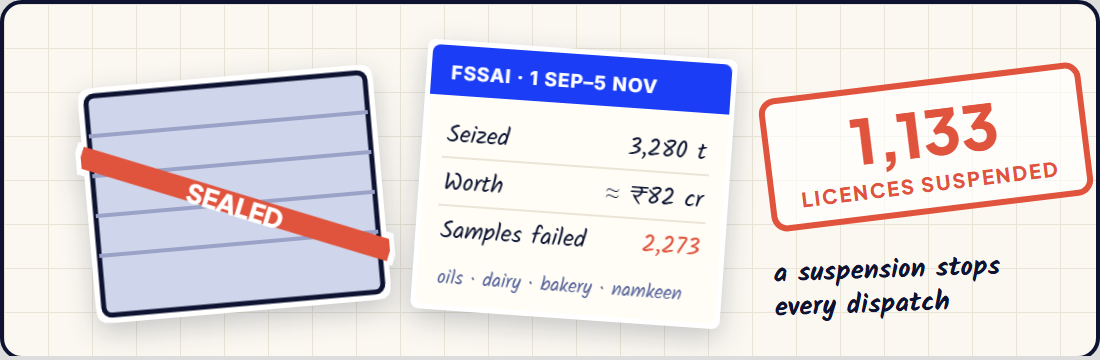

FSSAI’s festive drive: 3,280 tonnes seized and 1,133 licences suspended.
FSSAI said on 7 November 2026 that a nationwide drive from 1 September to 5 November seized about 3,280 tonnes of non-compliant food worth about ₹82 crore. It suspended 1,133 licences and cancelled 52. Of 23,648 samples tested, 2,273 failed. The seized items included oils, milk products such as paneer, khoya and ghee, bakery items, namkeen and ice cream.
Business Standard ·
Deccan Herald
Why it matters: a suspended licence stops dispatch for everything, not only the product that failed. Old stock that is still in your godown, unlabelled or past its date, is the kind of thing an inspector notices.
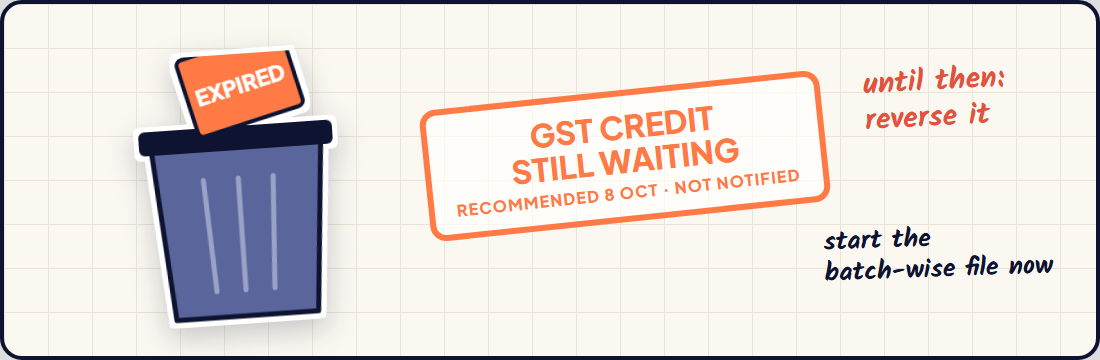

GST credit on expired stock: still waiting.
The GST Council recommended on 8 October 2026 that input credit be allowed on goods destroyed or written off when their shelf life ends, where the law requires it. As of mid-November, the change has not been notified, and no start date has been announced. Commentators expect it to apply only from the date it’s notified, not to earlier write-offs, and say plants will need batch-wise expiry, destruction and costing records to claim it.
TaxGuru
Why it matters: until it’s notified, keep reversing the credit on written-off stock. Start keeping the batch-wise file now, so you’re ready when it changes.


30 November: the last date for last year’s GST credit.
Input credit for invoices of 2025-26 can be claimed only up to 30 November 2026 (or the date you file the annual return, if earlier). After that, it lapses.
Daily Financial
Why it matters: this week, ask your accountant whether any supplier invoices from last year are still missing from your credit. It’s the same reconciliation that a write-off reversal needs.
Following up:
- Front-of-pack red labels: the Supreme Court has reserved its order, and we found no judgment yet.
- PMFME subsidy: no continuation announced since the scheme’s term ended on 30 September.
One AI use case worth watching: forecasting demand per product, so less stock reaches 60 days
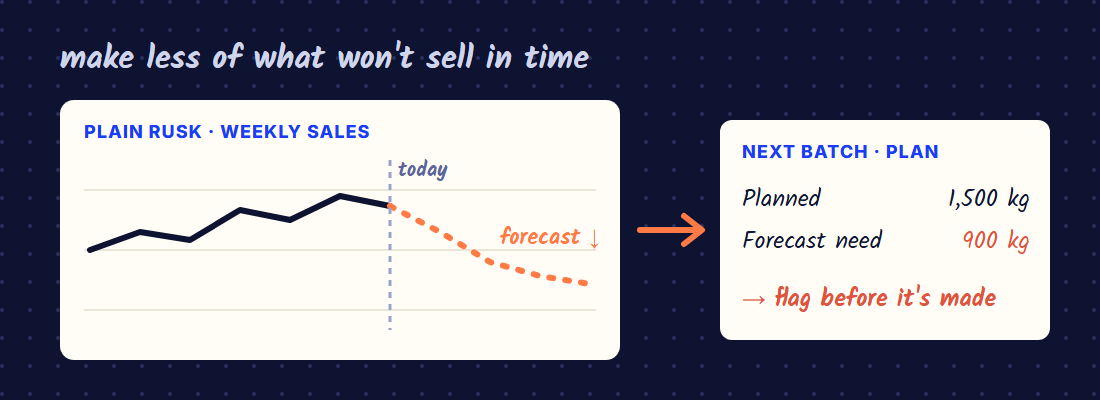
The review above deals with stock that’s already ageing. The cheaper fix is to make less of what won’t sell in time. In many small plants, the production plan comes from last month’s sales and the owner’s instinct. It works until a buyer drops an order or a season ends early.
Forecasting tools, some built into ERPs and some sold separately, use your own sales history per product and per channel. They account for the season, festivals and trends, and give a quantity to make for the next few weeks. When the forecast is lower than the planned batch, they flag it before the batch is made.
What it needs first: at least a year of sales by product and by channel, in one system, not in three Excel files; finished-goods stock by batch, so the tool knows what’s already in the godown; and someone who looks at the forecast every week and overrides it when they know something it doesn’t.
What it costs: often little for the tool. The work is getting clean sales history.
The honest limit: a forecast learns from the past. It can’t know about a new buyer, a lost distributor or a price war next month. For a plant with five products and three buyers, a weekly conversation with the sales team does the same job. It earns its keep once you have dozens of products across several channels.
Questions plants ask about near-expiry stock
What is FEFO, and is it different from FIFO?
FIFO issues the oldest receipt first. FEFO issues whatever expires first. They’re the same until two batches of the same product have different shelf lives. Then the batch made last can be the one that expires first. For finished goods with a shelf life, FEFO is the rule to follow.
Do we have to reverse GST credit on expired stock we write off?
Under the law as it stands, input credit on goods written off or destroyed is blocked, so the credit on their inputs has to be reversed. The GST Council has recommended a change for goods destroyed on expiry where the law requires it, but it isn’t in force until notified. Ask your CA how it applies to your products.
How much shelf life do buyers expect on delivery?
It depends on the buyer. FSSAI has asked online food sellers to deliver with at least 30% of shelf life or 45 days left. Modern trade and distributors usually set their own minimum in the agreement. Ask each buyer, write it down per channel, and work out your last-ship date from it.
Can we rework near-expiry stock?
Sometimes. It depends on the product, your process and what your FSSAI licence allows. If you do it, the reworked product needs its own batch record that shows where the old stock went, so a later problem can still be traced.
Who should decide on a near-expiry batch?
One named person, usually the production or plant manager, with sales in the room. Sales knows which channel can still take it; production knows what can be reworked. Write the decision against the batch.
What does your plant do with stock that’s close to its date? Discount, distributor, rework or write-off? Tell us at sales@digiwah.com. The most common answers will shape a later issue, with names removed.
Missed an issue? Batch 01: how long would your plant take to trace one batch? · Batch 02: where yield goes missing between the gate and the invoice · Batch 03: who checked this lot before it went into your batch?
The Batch is written by Bipanjeet Singh at Digiwah Technosys, a Zoho implementation partner in Mohali, building batch-wise expiry and FEFO in an ERP and GST credit reversal on written-off stock. It arrives on the 2nd and 4th Tuesday of every month at 7:30 am. Subscribers also get One Batch, Five Registers, our longer guide to batch records in food plants.
Next issue, Tuesday 8 December.
