

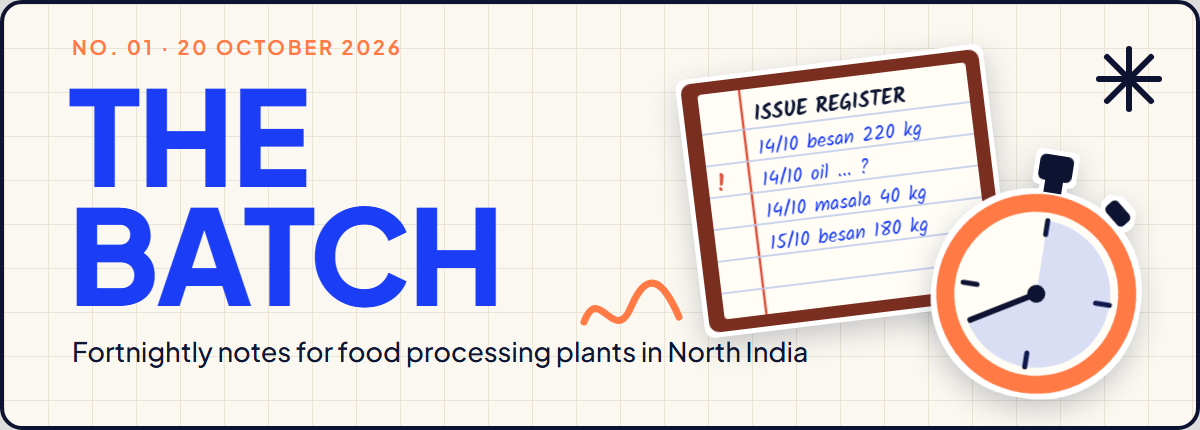
Most food plants can’t say how long it would take to trace one batch, and the honest answer is usually somewhere between half a day and two days. A one-hour mock recall drill tells you your own number this week, and shows which handover between registers is losing the batch code.
In this issue: a one-hour mock recall · three news items, including a new FSSAI rule on registers · one AI use case
Why does the time matter?
Since June, manufacturers have had to keep daily production and raw-material registers (more in the news below). Having the registers is the easy part. A recall tests whether they connect.
While a two-day trace runs, your batch keeps moving through distributors and onto shelves. And if you can’t prove which batches used a bad lot, the safe decision is to recall all of them.
How do you run a mock recall drill?
You need two people: your QC head, and someone from accounts or dispatch who hasn’t seen the drill before. Don’t warn the stores team. Start a stopwatch.
- Pick a batch dispatched two to four weeks ago to more than one customer.
- Go backwards. List every raw-material and packaging lot that went into it, including any blend or paste you make in-house.
- Go forwards. Take one lot used in many batches (oil, a spice) and find every batch and every dispatch it reached.
- Reconcile. Quantity made should equal quantity dispatched + in stock + samples + damages.
- Stop the clock and write down three numbers: minutes taken, registers opened, and how many times someone said “I think”.
A good target is under an hour, a quantity gap under 0.5%, and no “I think” at all.
What does a first attempt usually look like?
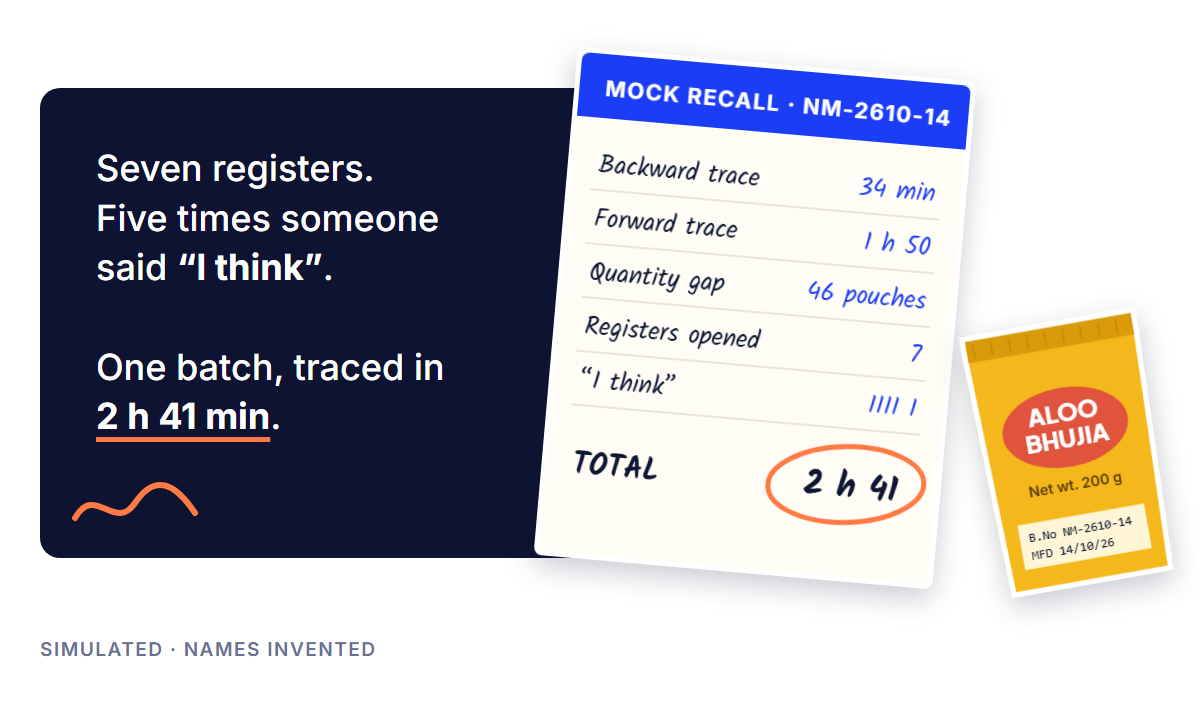
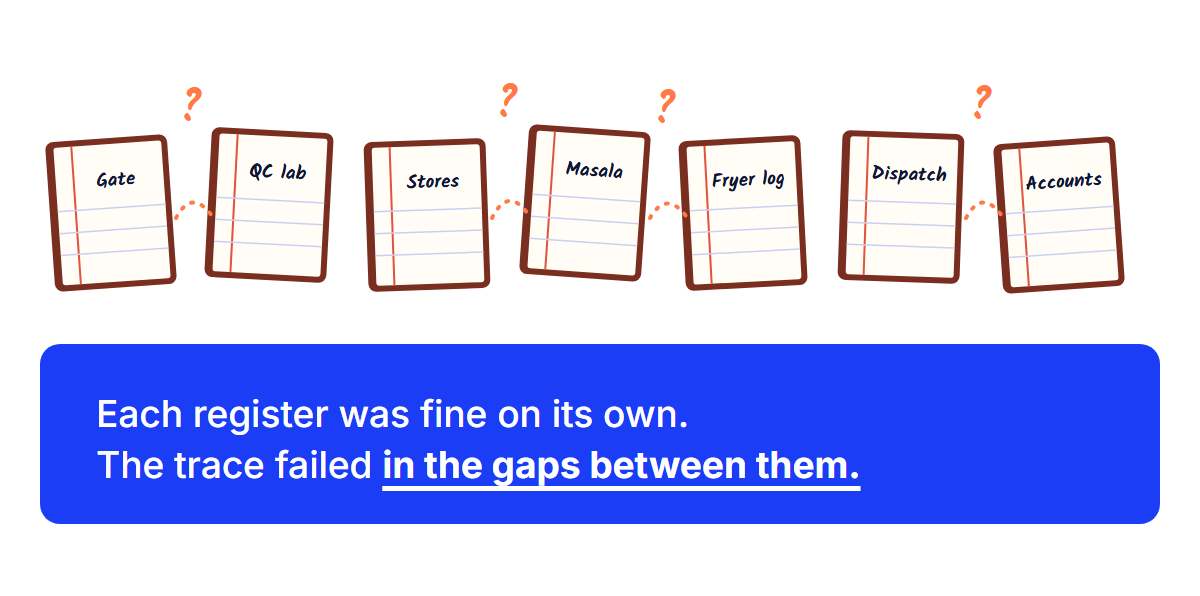
Nobody was slow. The batch’s story was split across seven registers, and the batch code dropped out every time it passed from one to the next:
- The masala blend had no batch code, so the trace jumped from bhujia straight to “spices”.
- The oil tank mixes lots. Nobody wrote down when the new lot went in, so every batch for a fortnight was a “maybe”.
- Forty sample pouches left on a delivery challan, which accounts can’t see when it searches invoices.
What would a ten-minute trace need?
One record per batch that every department writes into. Stores issues lots against the batch code. Production records blends and rework as inputs. Dispatch and accounts put the batch code on every invoice and challan. Then a trace is a lookup, not a search.
That’s what a batch-level ERP does in a food plant, but only if the habits are in place first. Software on top of registers that skip the batch code just gets you to “I think” faster. Run the drill first: it shows you exactly which handover to fix.
In the news
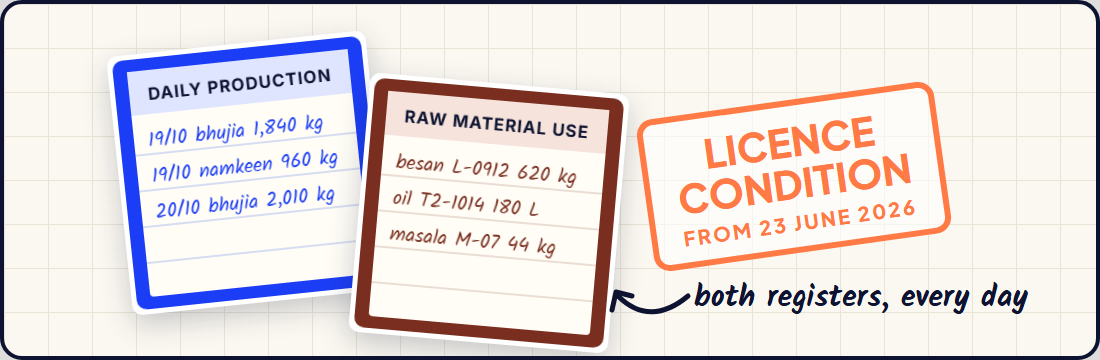
Daily production and raw-material registers are now a licence condition for manufacturers.
An amendment to the FSS licensing regulations, notified on 23 June 2026, requires manufacturing units to keep daily production records and separate records of raw-material use. It also requires raw materials, work in progress and finished goods to be stored on FIFO and FEFO. Traders, distributors and retailers are exempt from these two conditions. Summary on TaxGuru
Why it matters: these are the two registers the drill above leans on. An inspector can now ask to see both, and “we note it at month end” won’t hold up.

FSSAI wants perishables kept cold from procurement to delivery, with records.
An FSSAI advisory dated 15 October 2026, reported on 18 October, asks businesses handling khoa, paneer, meat and fish to keep them at prescribed temperatures through chilling, transport, warehousing and distribution. It also requires clean, covered vehicles and food-grade packaging, and consignment records that allow traceability. State food safety commissioners have been asked to step up checks, and the penalty includes seizure of the goods. The Tribune
Why it matters: if your dairy or meat product travels with a distributor, the transport log is now part of your trace, so a dispatch that can’t be tied to a vehicle and a temperature record is a gap.
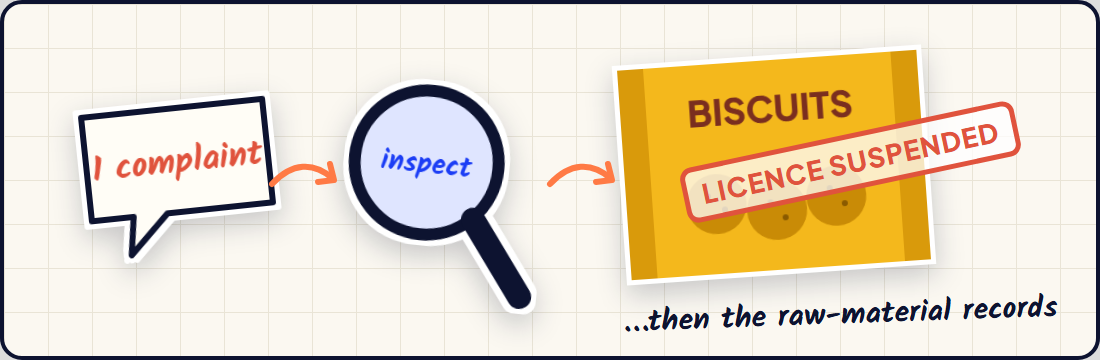
One complaint, one inspection, one suspended licence.
On 17 October 2026, FSSAI suspended the licence of a biscuit manufacturer after a consumer complaint led inspectors to find cattle-feed bran, still in bags marked as cattle feed, being used as an ingredient. Inspectors also recorded failures in storage, segregation and pest control. Business Today
Why it matters: the inspection started from one product and spread to how raw materials were stored and recorded. That’s the same ground a mock recall covers, only with someone else holding the stopwatch.
One AI use case worth watching: a camera that reads the batch code on every pack
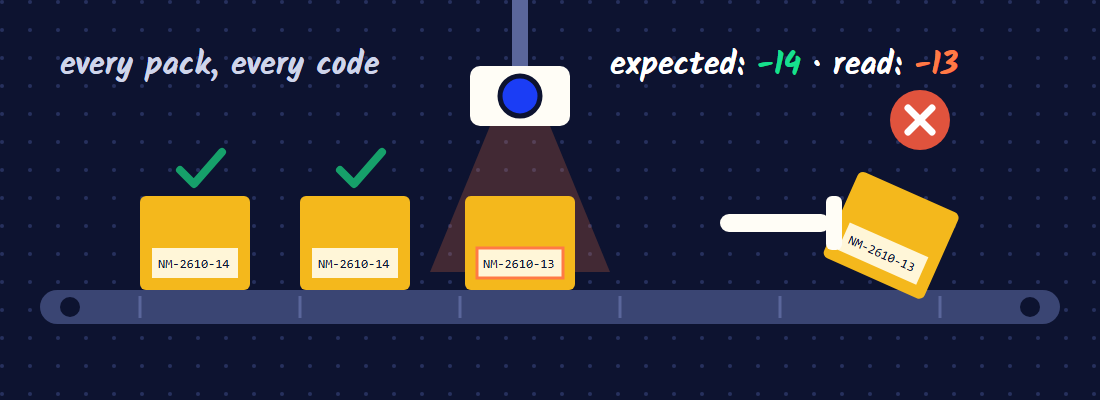
One handover the drill can’t test is the coding printer. If it’s still carrying yesterday’s batch code for the first forty minutes of a shift, those packs can’t be traced from paper at all. A photo of the first pack at every changeover helps, but it checks one pack in thousands.
Code-verification systems put a camera just after the coding printer. It reads the batch code, MRP and expiry date on every pack and compares them with what the line should be printing. A pack that’s wrong, smudged or blank is pushed off the belt before it reaches a carton. Newer systems use AI-based character reading, which copes with smudged inkjet print and slightly skewed packs better than the older fixed-rule cameras.
What it needs first: a coder fixed in one position, with consistent print quality; steady lighting at the camera, and a reject arm or air jet; and the hard part, the expected code fed from the batch record. If the camera doesn’t know what today’s batch code should be, it can only check that something is printed, not that it’s right.
What it costs: no reliable figure for a complete AI system in India. Basic industrial vision cameras from Indian suppliers are listed at roughly ₹1–4 lakh each before lighting, mounting and integration.
The honest limit: shiny or curved film is still hard to read, and the payback isn’t a saving you can see on a P&L. It’s the recall you don’t have. Worth it first on lines running more than one batch code a shift. A plant on one SKU a day is better served by the first-pack photo.
Questions plants ask about mock recalls
How often should a food plant run a mock recall?
At least once a year, and again after any big change: a new line, a new product, new software, or a new person in stores or dispatch. Plants that run one every quarter usually get much faster by the third run.
Should the mock recall go all the way to calling customers?
Not the first time. Run it internally until the trace and the reconciliation are reliable. Once they are, add a step where you call one trusted distributor and ask them to find the batch in their stock. That tests the last link, which is the one you don’t control.
Do we need software to trace batches?
No. A paper system where every issue slip, process log and dispatch document carries the batch code can trace a batch in under an hour. Software makes it faster and harder to get wrong, but only if those habits are already in place.
What’s the most common reason a trace fails?
Shared bulk ingredients (oil, sugar, salt) without a recorded changeover, and rework that is added back into later batches without being written down. Between them they account for most of the “I think” answers in a drill.
Is a mock recall the same as a traceability audit?
No. An audit checks that the records exist. A mock recall checks that you can use them under time pressure. Plants can pass the first and still fail the second.
Ran the drill? Send your three numbers (minutes, registers opened, and the “I think” count) to sales@digiwah.com. If enough plants send theirs, we’ll share the anonymised range in a later issue.
The Batch is written by Bipanjeet Singh at Digiwah Technosys, a Zoho implementation partner in Mohali, building batch-level ERP for food plants and invoices that carry batch codes. It arrives on the 2nd and 4th Tuesday of every month at 7:30 am. Subscribers also get One Batch, Five Registers, our longer guide to batch records in food plants.
Next issue, Tuesday 27 October: where yield goes missing between the gate and the invoice.
