

WhatsApp vs Email Marketing: Which Channel Delivers Better Results?
A data-driven comparison of open rates, engagement, conversions, and ROI
Last Updated: June 3, 2026
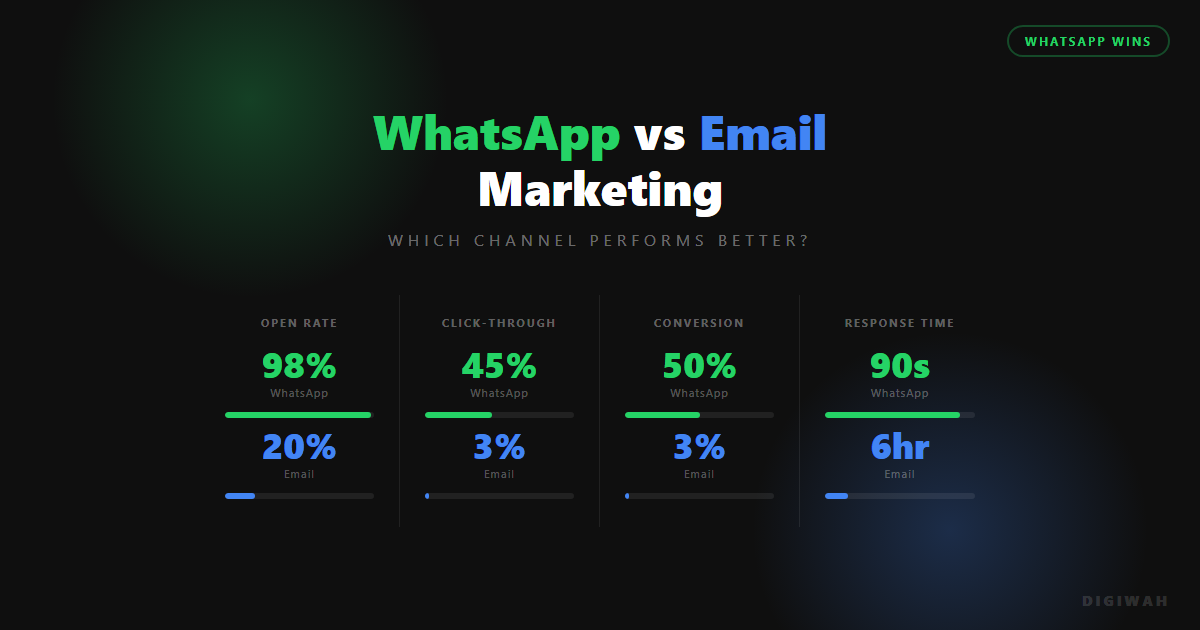
WhatsApp marketing delivers a 98% open rate versus email’s 20–25% — but the two channels win at different jobs. WhatsApp wins on speed, open rates, click-throughs, and conversions; email wins on long-form content, formal communication, and low-cost scale. For most businesses the highest-ROI answer is not one channel or the other — it is using both together, each where it performs best.
Both WhatsApp and email are essential digital marketing channels, but they serve different purposes and deliver dramatically different results. This guide breaks down the real numbers, explains when to use each channel, and shows you how to combine them for maximum business impact.
Table of Contents
WhatsApp vs Email: Head-to-Head Comparison
Before diving into the details, here is a side-by-side comparison of WhatsApp and Email marketing across all key metrics that matter for business growth.
| Metric | WhatsApp Marketing | Email Marketing |
|---|---|---|
| Open Rate | 98% | 20-25% |
| Read Speed | Within 5 minutes | Hours to days |
| Click-Through Rate | 15-80% | 2-5% |
| Conversion Rate | 45-60% | 1-5% |
| Message Format | Short, conversational | Long-form, detailed |
| Tone | Personal, informal | Professional, formal |
| Best For | Quick engagement, sales | Newsletters, documentation |
| Spam Risk | Very low | High (promotions tab, spam filters) |
| Two-Way Communication | Natural and instant | Slow and formal |
| Rich Media Support | Images, video, documents, location | Images, embedded content |
| Cost per Message | Higher (API-based pricing) | Lower (bulk pricing) |
| Scalability | Good (via WhatsApp Business API) | Excellent (mass email platforms) |
WhatsApp Marketing Performance
WhatsApp is the most widely used messaging app in the world, with over 2 billion active users. When businesses market through the WhatsApp Business API, the results are significantly stronger than traditional channels.
- 98% Open Rate — Almost every WhatsApp message gets opened. Unlike email, WhatsApp messages appear as push notifications, making them nearly impossible to ignore.
- 80% Read Within 5 Minutes — Messages are read instantly, not hours later. This makes WhatsApp ideal for time-sensitive offers, appointment reminders, and flash sales.
- 15-80% Click-Through Rate — Links and CTAs get strong engagement because messages feel personal and relevant. Personalized messages with customer names can push CTR to the higher end.
- 45-60% Conversion Rate — The conversational nature of WhatsApp makes it easy to guide customers through the buying process. Two-way communication builds trust and removes purchase hesitation.
Why WhatsApp Numbers Are So High
The reason WhatsApp outperforms nearly every other marketing channel comes down to three factors:
- Push notifications — Messages appear directly on the lock screen, ensuring visibility.
- Personal space — WhatsApp is where people talk to family and friends, so messages get immediate attention.
- Two-way communication — Customers can reply instantly, creating a real conversation that builds trust and drives action.
Email Marketing Performance
Email marketing remains one of the most established digital marketing channels. It is reliable, professional, and cost-effective for large-scale communication. However, its engagement metrics have declined over the years due to inbox overload and spam filters.
- 20-25% Open Rate — Only 1 in 4 emails are opened. Many land in the Promotions tab or spam folder, reducing visibility significantly.
- Checked Periodically — Emails sit unread until the user decides to check their inbox. There is no instant push notification like WhatsApp.
- 2-5% Click-Through Rate — Even when emails are opened, engagement is low. Users often skim or delete without clicking links.
- 1-5% Conversion Rate — The formal tone and one-way nature of email makes it harder to convert prospects into buyers.
Where Email Still Excels
Despite lower engagement numbers, email marketing has clear advantages in specific scenarios:
- Long-form content — Newsletters, detailed product updates, and educational content work better in email format.
- Formal communication — Contracts, invoices, legal notices, and compliance-related messages belong in email.
- Scalability — Email platforms like Mailchimp and Zoho Campaigns allow sending millions of messages at a fraction of the cost.
- Documentation trail — Emails create a searchable, permanent record of communication that is important for business operations.
Why WhatsApp Outperforms Email in Engagement
The gap between WhatsApp and email engagement is not a coincidence. It comes down to how people use these channels in their daily lives.
- Immediacy: WhatsApp is treated as real-time communication. People check WhatsApp 23+ times per day on average, compared to checking email 2-3 times.
- Personal Touch: WhatsApp feels like a one-on-one chat, not a mass broadcast. Personalized messages with the customer’s name and relevant context drive significantly higher responses.
- Higher Trust: Messages from verified WhatsApp Business accounts build credibility. Customers trust WhatsApp messages more because spam is rare on the platform.
- Mobile-First: WhatsApp is designed for smartphones, which is how 70%+ of internet users access content today. Email was designed for desktop and still feels that way on mobile.
- No Spam Folder: WhatsApp messages always reach the user. There is no promotions tab, no spam filter, and no inbox sorting to hide your message.
When to Use WhatsApp vs Email
The most successful businesses don’t choose one channel over the other. They use each channel for what it does best.
Use WhatsApp For:
- Flash sales and limited-time offers
- Appointment reminders and confirmations
- Order updates and delivery tracking
- Quick customer support and FAQs
- Personalized follow-ups after purchases
- Abandoned cart recovery messages
- Lead qualification and instant responses
- Event reminders and RSVPs
Use Email For:
- Detailed newsletters and industry reports
- Product launch announcements with full details
- Onboarding sequences for new customers
- Official and legal communication
- Monthly or weekly digests
- Transactional emails (receipts, invoices)
- Long educational content and guides
The Best Strategy: Combine Both Channels
Smart businesses don’t pick WhatsApp OR email. They use both channels strategically to cover the full customer journey.
Here is how an effective omnichannel strategy works:
- Capture leads via WhatsApp — Use WhatsApp click-to-chat ads or website widgets to start instant conversations. The 98% open rate ensures your first message gets seen.
- Nurture with email — Send detailed product information, case studies, and educational content via email sequences.
- Convert with WhatsApp — When it is time to close the deal, switch to WhatsApp for personalized offers and instant responses to buying objections.
- Retain with both — Use WhatsApp for quick check-ins, support, and loyalty offers. Use email for monthly newsletters and product updates.
How to Get Started with WhatsApp Marketing
If your business is not yet using WhatsApp as a marketing channel, here is how to start:
- Set up a WhatsApp Business account — Download WhatsApp Business (free) or apply for the WhatsApp Business API for advanced features like automation, chatbots, and bulk messaging.
- Build your contact list — Collect opt-in consent from customers through your website, social media, and in-store interactions.
- Create message templates — Design pre-approved message templates for common scenarios: welcome messages, order confirmations, appointment reminders, and promotional offers.
- Automate with a platform — Use a WhatsApp automation platform to schedule messages, set up auto-replies, and manage conversations at scale.
- Track and optimize — Monitor open rates, click-through rates, and conversions. A/B test different message formats to find what works best for your audience.
Frequently Asked Questions
Ready to Start WhatsApp Marketing for Your Business?
Get expert guidance on setting up WhatsApp automation that delivers real results. See how we’ve helped other businesses in our case studies.
